
Describe your facility
Tell us about your space, current system (if any), and what you are trying to accomplish.
Ductless mini split systems are widely used in commercial settings such as offices, retail spaces, restaurants, server rooms, and multi-tenant buildings, often where extending traditional ductwork is impractical or where different tenants or zones need independent climate control. National Mini Split Pros helps connect business owners and property managers with local HVAC professionals for commercial mini split installation, repair, and maintenance.
Commercial applications often involve higher duty cycles, larger capacity requirements, or specialized needs like precise temperature control for server equipment, which makes working with a technician experienced in commercial ductless systems particularly valuable.
Tell us about your space, current system (if any), and what you are trying to accomplish.
We help connect you with a local HVAC professional experienced in commercial ductless systems.
The technician evaluates your space and provides a plan and cost estimate before work begins.
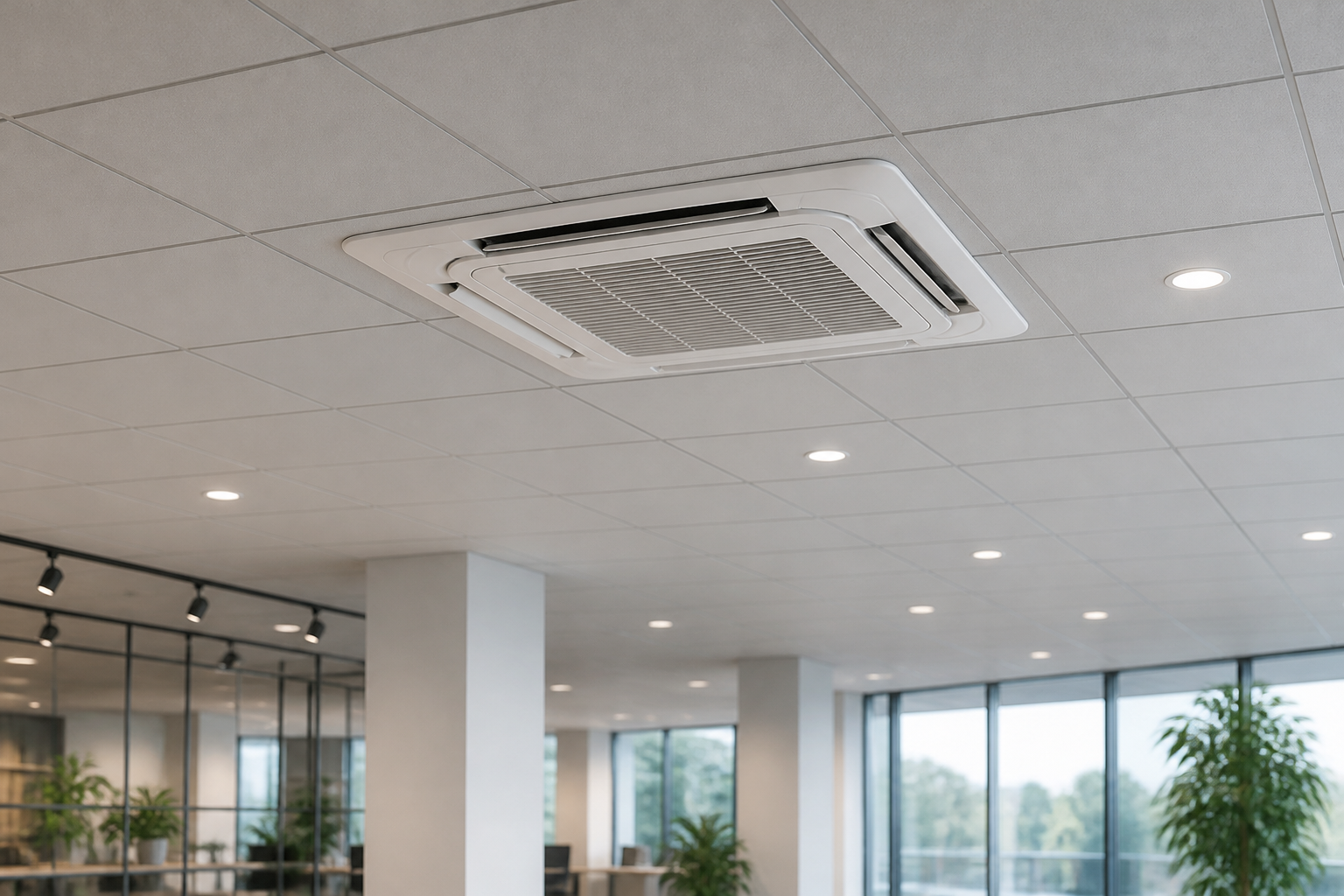
Ceiling-mounted cassette units are popular in commercial spaces because they condition a room without taking up wall space, which matters in retail and office layouts. Server rooms and other equipment spaces often use dedicated mini splits sized for continuous operation and precise temperature control, sometimes with backup units in case of failure given how costly downtime can be.
Restaurants and commercial kitchens present a different challenge, since extreme heat and grease-laden air from cooking areas require equipment and placement decisions a residential-focused installer may not be familiar with.
A commercial assessment typically covers the full space's heat load (factoring in equipment, occupancy, and glazing, not just square footage), existing electrical capacity, and any building code or landlord approval requirements specific to commercial properties. For multi-tenant buildings, metering and billing separation between units is often part of the conversation as well.
Maintenance contracts are also more common in commercial settings than residential ones, since unplanned downtime has a direct cost to the business, and many commercial property owners prefer scheduled service visits over waiting for a breakdown.
Commercial ductless work often differs from residential installation in scale, equipment, and code requirements, so experience with commercial properties specifically is worth asking about when evaluating a local HVAC professional. A technician comfortable with a single-family home installation is not automatically equipped for a multi-tenant building's electrical capacity questions or a restaurant kitchen's ventilation interactions.
It is also reasonable to ask about response time commitments for business accounts, since a retail space or office losing climate control during business hours has different urgency than a residential callout, and many commercial clients prioritize this when comparing local HVAC professionals.
Commercial electricity rates and usage patterns differ from residential ones, often with demand charges that penalize high peak usage rather than just total consumption. Because mini splits use inverter-driven compressors that modulate output rather than cycling fully on and off, they can help smooth out demand spikes compared to older, single-stage commercial equipment.
For businesses tracking operating costs closely, asking a local HVAC professional about expected run-time patterns and typical energy use for a proposed system, based on similar properties they have serviced, can help with budgeting beyond the installation quote itself.
Many commercial-grade mini split models are built for higher duty cycles than residential units. A technician can recommend equipment suited to your facility's actual usage pattern.
Commercial HVAC work often involves additional permitting, inspections, or landlord approvals beyond residential requirements, and these vary by city and building. Your local technician can advise on what applies.
Yes, with correct sizing and consideration for continuous operation. Some server rooms use backup or redundant units given the cost of unexpected downtime.
For many businesses, scheduled maintenance that catches problems before a breakdown is worth the predictability, particularly where downtime has a direct cost. Your technician can discuss options for your situation.
Call National Mini Split Pros and we'll help connect you with a local HVAC professional for commercial mini split services.