
Describe your space
Tell us the rooms or square footage you want to heat and cool, and whether you are considering single-zone or multi-zone.
Ductless mini split systems are one of the most common ways to add cooling and heating to a space without existing ductwork, whether that is a room addition, an older home, a garage conversion, or a small office. A mini split pairs one or more indoor wall-, ceiling-, or floor-mounted units with an outdoor condenser, connected by a refrigerant line set and a small wall penetration rather than ducting.
National Mini Split Pros helps homeowners and businesses connect with local HVAC professionals for new installation, whether that is a single indoor unit serving one room or a multi-zone system serving several rooms from one outdoor condenser.
Tell us the rooms or square footage you want to heat and cool, and whether you are considering single-zone or multi-zone.
We help identify a local HVAC professional for an in-person assessment and sizing recommendation.
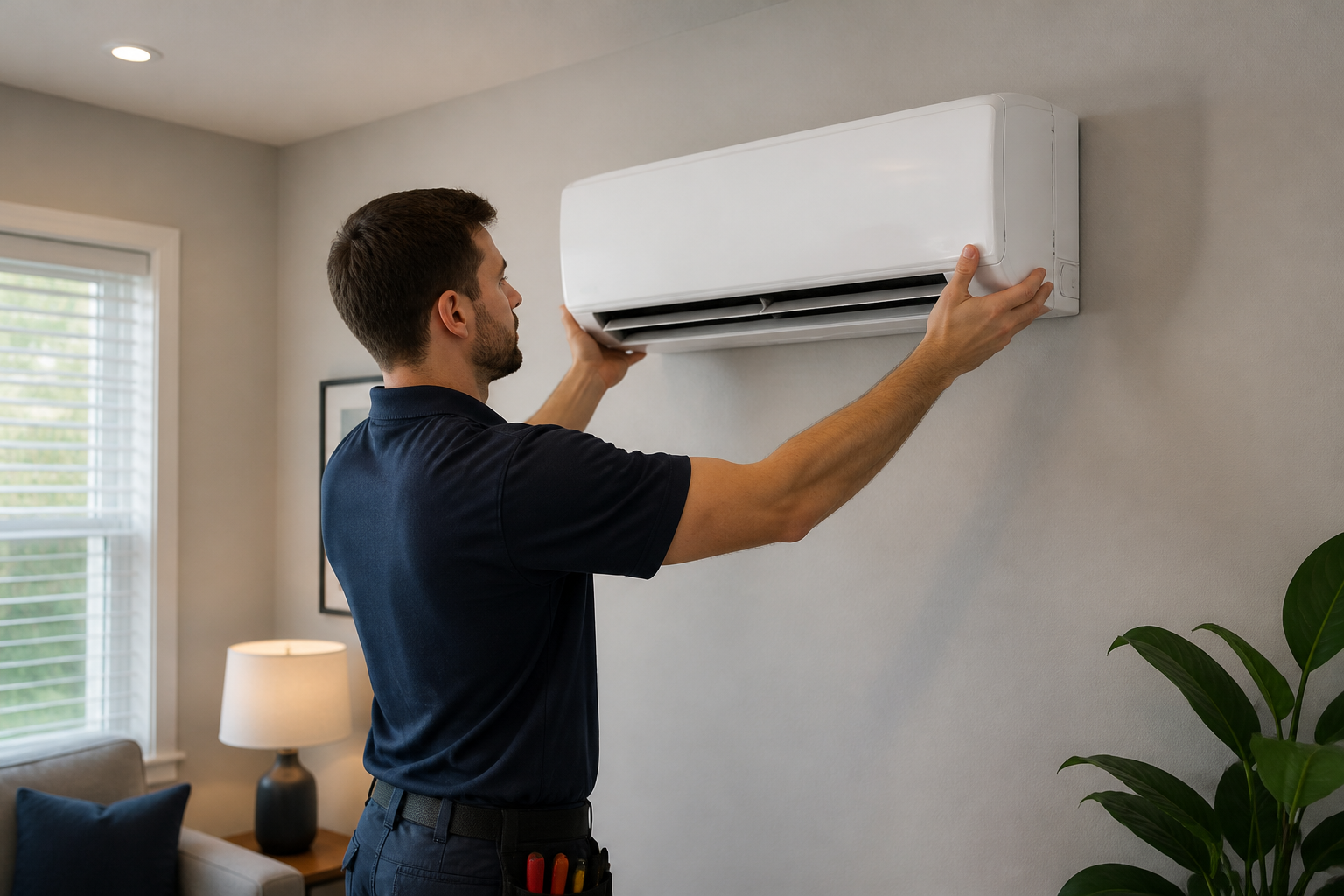
The local technician installs the indoor and outdoor units, runs the line set, and walks you through operating the system.
A single-zone system pairs one outdoor condenser with one indoor unit, and is the simplest and generally most efficient option when only one room or open area needs conditioning. A multi-zone system connects one larger outdoor condenser to two or more indoor units, each with its own thermostat, so different rooms can be set to different temperatures independently.
Multi-zone systems cost more upfront than adding several single-zone systems separately, but they require only one outdoor unit and one set of electrical and refrigerant connections to the outside, which can simplify installation in homes where outdoor space or electrical capacity is limited.
Correct sizing is the single biggest factor in whether a new mini split performs well. An oversized unit cools a room quickly but cycles on and off frequently, which leaves humidity poorly controlled and wears components faster. An undersized unit runs constantly and still may not keep up on the hottest or coldest days.
A proper sizing assessment accounts for square footage, ceiling height, insulation quality, window area and orientation, and how many people typically use the space, not square footage alone. This is one of the main reasons an in-person assessment from a local technician matters more than an online BTU calculator.
Mini splits are rated for cooling efficiency using SEER2 (Seasonal Energy Efficiency Ratio) and for heating efficiency using HSPF2 (Heating Seasonal Performance Factor). Higher numbers mean more cooling or heating output per unit of electricity used. Because mini splits use inverter-driven compressors that adjust their speed to match demand rather than simply switching on and off at full power, they typically run more efficiently than older single-stage window or central systems, especially at partial load.
It is worth asking any installer what efficiency tier a proposed system falls into and whether it qualifies for local utility rebates or federal tax credits, since eligibility and incentive amounts change and vary by location. A local HVAC professional familiar with your area's current programs is better positioned to answer this than a generic online estimate.
A proper installation does not end when the units are mounted. The refrigerant line set needs to be evacuated and pressure-tested before the system is charged, and most manufacturers specify a startup checklist covering refrigerant charge verification, electrical connections, and condensate drainage before a new system is considered complete.
Before the technician leaves, you should receive a walkthrough covering how to operate the thermostat or remote, what the filter maintenance schedule looks like, and what warranty coverage applies to parts and labor. Keeping the documentation from this walkthrough is useful if you ever need warranty service down the line.
A single-zone installation is often completed in a day. Multi-zone systems with several indoor units typically take longer, depending on the number of zones and the complexity of the line set routing.
Permit requirements vary by city and county. The local HVAC professional handling your installation can tell you what applies in your area.
Most modern mini splits are heat pump systems, meaning they provide both heating and cooling from the same unit. Some models are cooling-only, so confirm which type fits your needs when discussing installation.
The outdoor condenser needs a stable, level surface with clearance for airflow, reasonably close to the indoor unit to keep the line set run efficient. A technician will evaluate the best location during the in-person assessment.
Call National Mini Split Pros and we'll help connect you with a local HVAC professional for mini split installation.